How to Choose the Best Balloon Blower for Your Business?
Choosing the best Balloon Blower for your business starts with understanding how and where you work. A shop preparing garlands all day has different needs from a small event team inflating balloons at several venues. The right machine should fit your typical balloon sizes, daily workload, and available workspace. Small details matter. Check nozzle sizes, power source, carrying weight, and how easily the unit can be stored. Noise matters, too, especially in a busy shop or quiet event space. A low price can look appealing, but it may not reflect long-term performance or service needs.
Before buying, compare product specifications with your actual workflow. Look for clear information about airflow, operating limits, warranty coverage, and replacement parts. If possible, test the blower with the balloons you use most often; inflation speed and fit can vary by balloon type. Consider whether one or two outlets will keep your team moving, rather than creating a queue at the worktable. It is easy to focus on speed and overlook comfort, cleanup, or maintenance. I would not assume the largest machine is automatically the best choice. A practical decision balances reliability, portability, operating cost, and support from the supplier. This guide explains what to assess, which trade-offs deserve attention, and how to choose a Balloon Blower that suits your business rather than just its product listing.
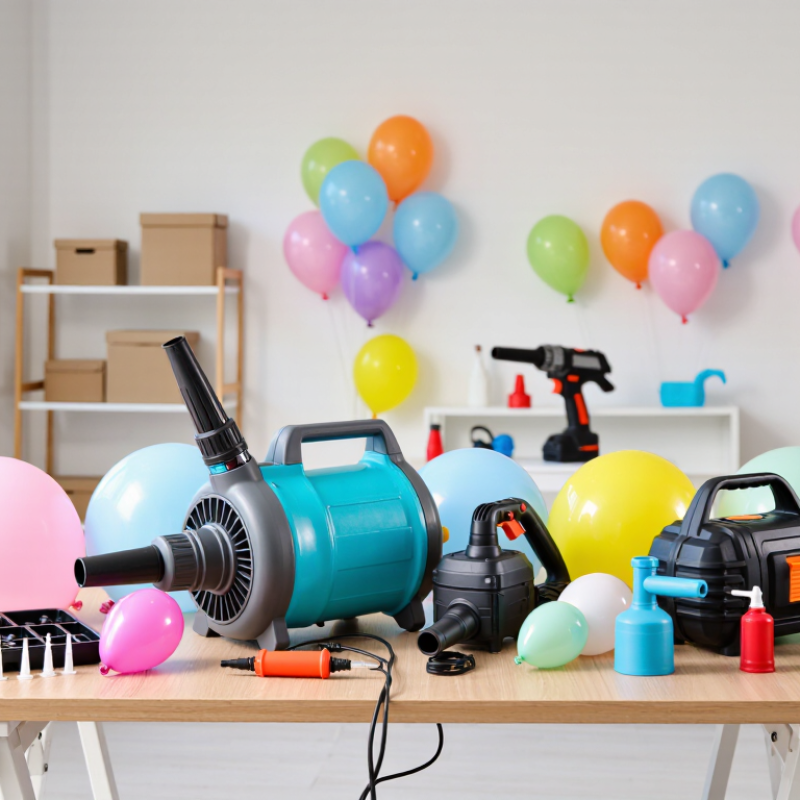
Define Daily Output Needs Around Qualatex’s Common 11-Inch Latex Balloon Size
Plan around balloons per day and the busiest hour, not a pump’s headline speed. An 11-inch sphere holds about 11 liters by geometric estimate; latex shape makes this an imperfect planning figure. At 200 balloons daily, allow roughly 2,200 liters of air. If most orders arrive within one hour, the workload is very different from spreading inflation across a full shift. A target of 100 balloons per hour requires at least 18 liters per minute of delivered air, before handling time, pauses, or rejects. Treat that as a floor, not a promise.
For a central compressed-air setup, the U.S. Department of Energy’s Improving Compressed Air System Performance sourcebook reports that leaks can waste 20–30% of compressor output in many systems. That figure does not apply automatically to portable electric inflators, but it is a useful warning: rated capacity and usable output can differ. Time a real batch using your usual nozzle, balloon size, and staff workflow. Record the result. It may expose a weak point you did not expect.
Tips: Compare delivered airflow, duty cycle, and noise, then test a 20-balloon batch. Include setup and tying time. A practical buffer helps, though the right margin depends on your order peaks.
How to Choose the Best Balloon Blower for Your Business? — Define Daily Output Needs Around a Common 11-Inch Latex Balloon Size
Use this planning guide to match your daily target with blower capacity. The estimates assume four productive inflation hours per day and include a 25% capacity allowance for normal workflow variation.
| Daily Balloon Target | Required Effective Rate | Average Time per Balloon at That Rate | Suitable Blower Setup to Consider | What to Check Before Buying |
| About 100 | At least 32 balloons per hour | About 113 seconds | Handheld or compact single-outlet electric blower | Ease of use, convenient storage, and a nozzle that fits the balloon neck securely. |
| About 250 | At least 79 balloons per hour | About 46 seconds | Single-outlet electric blower suited to repeated daily use | Comfort during extended operation, inflation control, and the maker’s stated duty cycle. |
| About 500 | At least 157 balloons per hour | About 23 seconds | High-output single station or a two-station setup | Measure your real fill-and-tie cycle; consider whether a second operator or station is needed. |
| About 1,000 | At least 313 balloons per hour | About 12 seconds | Multiple stations or a higher-throughput electric setup | Confirm continuous-use limits, electrical requirements, noise level, and access to replacement parts. |
| About 2,000 | At least 625 balloons per hour | About 6 seconds | Several coordinated stations or a production-oriented setup | Test the complete workflow, including balloon handling, tying, quality checks, and operator breaks. |
Compare Airflow, Pressure, and Manufacturer-Rated Balloons per Minute
When comparing balloon blowers, treat airflow and pressure as different clues, not competing headline numbers. Airflow describes how much air moves; pressure indicates the force available to inflate a balloon against its resistance. High airflow can speed up filling standard balloons, while larger or firmer balloons may need steadier pressure. Test with the balloon sizes you actually use. Small details matter.
Manufacturer-rated balloons per minute is useful only when you know the test conditions. Check the balloon size, material, nozzle, and whether the rate assumes continuous operation or short bursts. A figure measured with small balloons may not match your event work. Numbers need context. Ask for a demonstration, then time a batch of twenty. Note uneven inflation, pauses, and how often staff need to change balloons—not only the fastest result.
Noise, heat, and ease of controlling airflow also affect a busy workday. A short trial can mislead: operator technique and setup may change the result. Record your own timed batches, using the same balloon type and routine for each machine. Compare those results with the manufacturer’s rating, and ask how the blower is intended to be used during extended sessions.
Match Motor Duty-Cycle Ratings to Your Business’s Continuous Workload
A balloon blower’s duty-cycle rating tells you how long its motor can run before it needs to cool. This matters when orders arrive in steady batches, not just during occasional setup. A blower rated for brief use may handle a few decorations, then overheat during a busy hour. Check the manufacturer’s specification sheet for the rated run time and required rest period. Check the label.
Estimate your real workload before choosing. Count the balloons you typically inflate per hour, including larger sizes and clusters that take longer to fill. Then compare that pace with the blower’s rated operating time. If staff will use it continuously, choose a model designed for continuous or extended operation, rather than relying on short bursts between customers. Keep the intake clear, and note whether warm air or a hot casing appears during normal use. Stop and let the unit cool if it becomes unusually hot.
Leave some capacity for peak periods, but do not assume the biggest motor is automatically the best fit. A larger unit may add cost, noise, or unnecessary power use. It is easy to underestimate rush-hour demand; a simple trial with your usual balloons can reveal gaps in your estimate. Duty-cycle numbers can also be presented differently, so confirm how the rating is measured before comparing models.
How to Choose the Best Balloon Blower for Your Business?
Match the motor’s duty-cycle rating to the blower’s estimated active running time during a typical hour.
How to read this chart: Choose a motor rating whose permitted operating time meets or exceeds your estimated workload. The duty-cycle limits shown are illustrative calculations for one hour—for example, a 25% duty cycle equals 15 minutes of operation per hour. Always check the specific motor’s rating and required rest period; workload estimates are examples, not product specifications.
Check Noise Exposure Against NIOSH’s 85 dBA, 8-Hour Recommended Limit
Choosing a balloon blower is not only about speed and airflow. Noise matters when staff work beside it for hours. NIOSH recommends limiting occupational noise exposure to 85 dBA over an eight-hour workday. This is a recommended exposure limit, not a guarantee that every workplace is safe. Exposure adds up across the day, including noise from other equipment.
Check the sound level where the operator stands, not only near the machine. A calibrated sound level meter gives a better reading than a phone, which is useful for rough screening but may be inaccurate. Compare models under similar conditions, with the blower running and staff working nearby.
The NIOSH limit uses a 3 dB exchange rate: each 3 dB increase halves the recommended exposure time. Small changes matter. I once underestimated background noise from nearby equipment; the reading was higher than expected.
Tips: Ask suppliers for measured noise data, then verify it in your space. Place the blower away from workstations when practical, and consider barriers or quieter operating periods. Recheck readings after rearranging the room. If exposure may exceed recommendations, consult a qualified safety professional. Readings can vary, so do not rely on one quick test.
Apply CPSC Balloon Safety Guidance for Children Under 8
A balloon blower should support controlled inflation, but child safety starts before the motor runs. The U.S. Consumer Product Safety Commission warns that children under eight can choke or suffocate on uninflated balloons and broken balloon pieces. CPSC incident data recorded 111 child deaths involving balloons between 1973 and 1995. That history deserves attention at every party station, not just in written policies.
Keep uninflated balloons and scraps behind the counter, away from children. Assign an adult to supervise closely, and remove popped pieces immediately. Small pieces matter.
Choose a blower with a steady, manageable airflow so staff can avoid overfilling balloons and creating sudden bursts. Still, equipment cannot supervise a child.
A rushed setup can make even a sensible checklist easy to miss; place a waste container beside the inflation area and keep the adult’s view clear. Explain the rules in plain language to customers, especially when young children are present.
A blower is a business tool, not a safety barrier.
